
Bed Bugs: What They Look Like at Every Stage, the Bites, Where They Come From and How to Get Rid of Them
Bed bugs are flat, lentil-sized insects that hide in mattress seams and bite at night. Learn what they look like, how to spot the bites and why they come back.
 Ministry of Health licenceLicence 32 · Reg. 90🔍 Tap to enlarge
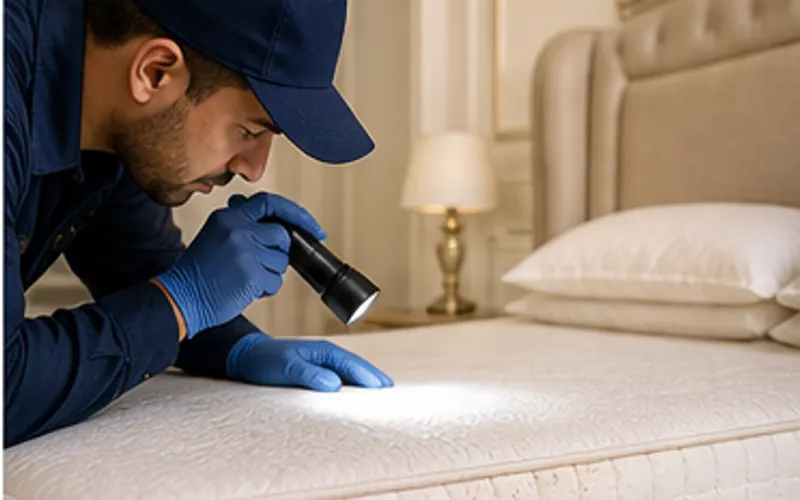
Bed bugs are small, flat, oval insects, reddish-brown and about the size of a lentil. They live in mattresses, bed frames and sofas and feed on human blood while you sleep. The classic signs are a line or cluster of bites in the morning and tiny black dots along the mattress seams. Getting rid of them means finding exactly where they hide and treating those spots at least twice, because the eggs survive the first round.
What exactly is a bed bug?
Its scientific name is Cimex lectularius, and it eats only blood, never crumbs or rubbish like a cockroach. That’s why you always find it near where people sleep.
Bed bugs usually come out before dawn, when you sleep most deeply, drawn by the carbon dioxide in your breath and your body heat. A feed takes 3 to 10 minutes, then the bug hides again for a few days to digest.
They can’t fly or jump and have no working wings, so they only walk. They climb wood, fabric and rough walls easily but struggle on smooth glass and polished plastic, which matters later for prevention.
A note on names: in Egypt, “ba’” (بق) means bed bugs, but in some Arab countries it means mosquitoes. Check that Arabic sources from elsewhere mean the same insect.
What do bed bugs look like at each stage?
Many people see one picture of an adult, then find something tiny and see-through on the sheet and decide it isn’t a bed bug. Each life stage looks different.
Eggs
An egg is about 1 mm long, pearly white or cream, like a very small grain of rice. The female glues eggs into cracks, seams and rough wood, so shaking the sheet won’t dislodge them.
They sit singly or in small groups and are hard to spot without a torch. At room temperature they hatch in a week to ten days, leaving an empty transparent shell behind.
Nymphs (young bed bugs)
The hatchling, a nymph, is a small copy of the adult: about 1.5 mm and almost clear with a yellowish or whitish tint, easy to miss on a light sheet.
It passes through five stages and must feed at least once at each before it can moult. Every moult leaves an empty light-brown skin shaped exactly like the bug, one of the clearest signs you can find.
Adult bed bugs
Adults are 5 to 7 mm long, the size of an apple seed or a lentil. Unfed, the body is oval and paper-thin, thin enough to slip between two boards.
They have six legs, two short antennae and faint bands across the abdomen. There are no wings, only tiny wing pads visible up close.
Colour before and after feeding
Unfed, a bed bug is flat and light brown or reddish-brown, and young nymphs look almost clear.
After feeding, the body swells and turns deep red or almost black, and a young nymph shows an obvious red spot in its belly. Crush a fed bug and it leaves a blood stain, often the source of those small marks on your pillow.
Insects that get mistaken for bed bugs
Before deciding, compare what you found with these:
- Cockroach nymphs run fast, have very long antennae and live in kitchens and bathrooms, not beds. In Cairo flats it’s usually the small German cockroach.
- Fleas are smaller, flattened from side to side, jump a long way and usually come with a cat or dog.
- Carpet beetle larvae are hairy, like tiny light-brown caterpillars, and the adult is round and speckled. Neither bites.
- Ticks have eight legs and stay attached to the skin. Bed bugs feed and leave.
- Dust mites are invisible to the naked eye. If you can see it, it isn’t one.
If you’re unsure, catch the insect on clear tape, photograph it close up in good light and send the picture to someone who knows. It saves days of guessing.
Bed bug bites: what they look like and how to tell them apart
You don’t feel the bite. The saliva numbs the skin and stops blood clotting, so you sleep through it.
A bite is a small raised red bump, sometimes with a darker centre. The itch ranges from severe to barely noticeable, and bites appear on skin exposed during sleep: arms, neck, face, shoulders, back and uncovered legs.
The giveaway is a line or cluster of 3 or 4 bites close together, because the bug moves a little and bites again, or several bugs feed on the same patch of skin.
Marks can appear hours or even a day or more later, which hides the source. Some people don’t react at all, so two people can share a bed with only one showing bites. Usually both are being bitten.
Bed bug bites vs mosquito bites vs flea bites
| Feature | Bed bug bites | Mosquito bites | Flea bites |
|---|---|---|---|
| Where on the body | Skin exposed during sleep: arms, neck, face, shoulders | Any exposed skin, night or day | Mostly legs, ankles and around the waist |
| Pattern | A line or cluster of 3 or 4 bites | Scattered and random | Small, tight groups |
| Appearance | Raised red bump, sometimes with a dark centre | Pink or white swelling that appears quickly | Small dot with a red ring around it |
| When it shows | Hours, a day or longer | Within minutes | Fairly quickly |
| Felt at the time? | Usually not | Sometimes, and you hear the buzzing | Sometimes a sharp prick |
| Other signs at home | Black dots, blood spots on sheets, cast skins in seams | Buzzing at night, standing water nearby | A cat or dog at home, insects that jump |
Use the table to narrow things down, not as a verdict. Skin reacts differently from person to person, and some allergies and skin conditions look similar, so anyone who says “that’s bed bugs” from a photo of a bite is guessing. The proof is the bug itself, its droppings, cast skins or eggs.
Are bed bug bites dangerous?
Bed bugs are not known to pass diseases to people. What wears people down is the itching, lost sleep and anxiety, and some stop sleeping in their own bed.
Heavy scratching can break the skin and let it become inflamed. If you have a severe allergic reaction or the skin looks infected, see a doctor.
Signs of bed bugs in your home
Bites make you suspicious. These signs confirm it:
- Black or dark-brown dots the size of a pen tip on mattress seams, sheets or the bed frame. These are droppings of digested blood: wipe one with a damp cotton bud and it smears reddish-brown like ink. Dust doesn’t.
- Small smeared blood spots on the sheet or pillowcase, usually from a bug crushed as you turned over.
- Empty skins, clear or light brown, shaped exactly like the bug, tucked into corners.
- Tiny white eggs or empty egg shells stuck in cracks and wood.
- A stale, oddly sweet smell some compare to coriander, noticeable only in large infestations.
- The bugs themselves, alive or dead, on the sheet or the wall beside the bed.
How to check your bed yourself
You need a strong torch (a phone light works), an old plastic card and about fifteen minutes:
- Peel back the sheet and duvet slowly, check the underside, then bag them and tie the bag.
- Go along every mattress seam, especially the corners and head end, running the card’s edge along it to push out anything hiding.
- Lift the mattress and check the base: slats, screws and every point where pieces of wood meet.
- Check the back of the headboard, especially if it’s fixed to the wall. We find bed bugs there very often.
- Open the bedside drawers and look in the inside corners and underneath.
- Check any sofa someone sits or sleeps on for long periods, under the cushions and in the lower seams.
- Photograph anything you find close up before wiping it away or killing it. You’ll need that picture.
If you find nothing but the bites continue, don’t relax yet. Early infestations are a few well-hidden bugs, so check again in a few days or ask a technician to inspect.
Where bed bugs hide in a flat
A small infestation usually sits within a metre or two of where someone sleeps. As numbers grow, bed bugs spread to sofas, curtains and neighbouring rooms.
In the bedroom
Start with the mattress: seams, edges, under the label and around any buttons. Then the bed base, sprung or slatted, with its joints, screws and gaps.
The headboard is a favourite, especially carved or upholstered ones. Then the bedside table, the top folds of curtains, carpet and rug edges, and the skirting board.
People forget the spots behind picture frames, inside sockets and light switches, under peeling wallpaper, and in cracks in the wall or door frame near the bed.
In the living room
A sofa that someone sleeps on or sits on for hours each day becomes a second nest. Bugs hide in the seams, under cushions, in the lining underneath and inside the frame. Fabric armchairs are the same.
Places you wouldn’t expect
Suitcases under the bed or on the wardrobe. Boxes and piles of clothes. Soft toys. Books on the bedside table. An alarm clock or charger, which has openings and stays warm. Every pile beside the bed is one more spot to inspect and treat.
Where do bed bugs come from? Is it about cleanliness?
People ask this with some embarrassment. Bed bugs don’t come from dirt or damp: something or someone carries them in.
The most common ways bed bugs get in
Travel comes first: a hotel, a holiday flat on the coast, a sleeper train, a long-distance bus. Bugs crawl into an open suitcase and come home with you.
Second-hand furniture is next. A mattress, sofa or fabric chair from a second-hand market or online listing can look clean with bugs inside the seams.
In apartment buildings, neighbours are a third route. Bugs travel between flats through gaps around pipes and electrical conduits and under doors, especially when a neighbour sprays something strong and they flee.
Less often it’s a guest’s luggage, shared housing such as student or worker accommodation, or clothes from an infested home.
So cleanliness plays no part?
A clean home won’t keep bed bugs out, because they live on blood, not food. Clutter is what matters: the more piled around the bed, the more hiding places and the harder the treatment.
So don’t blame yourself. Work out where they came from so you don’t bring them in again.
When are bed bugs most common during the year?
Bed bugs live indoors, so unlike mosquitoes they’re around all year. Temperature still matters.
In warm weather the whole cycle shortens, which is why a small infestation can grow quickly in an Egyptian summer. Summer also means travel, beach trips and furnished rentals, so more chances to ride in luggage.
In winter the cycle slows a little, but homes stay warm and the bugs still feed every night. If you see signs in winter, don’t wait for summer.
The bed bug life cycle, and why they come back after spraying
People say bed bugs “never die”. They do, but their life cycle makes a half-finished treatment look like a failure.
A fed female lays one to several eggs a day, hundreds in her lifetime. Eggs hatch in a week to ten days, and each nymph needs blood at each of its five stages. In a normal home, egg to adult takes about five weeks to two months, faster in the heat.
Adults live for months and can go without feeding for months in cool conditions. Lock the bedroom for a two-week trip hoping they’ll starve, and they’ll be waiting when you return.
Why do they come back?
First, the eggs. Most insecticides barely affect them, so after one treatment the eggs hatch a week later and the cycle restarts. “The spraying didn’t work” usually means the follow-up visit was missing.
Second, the spray didn’t reach them. The bugs were in a crack in the bed frame or behind a socket while the spray landed on the mattress and floor.
Third, resistance. In many parts of the world bed bugs now resist common shop-bought insecticides. Using the same spray repeatedly selects the toughest bugs and leaves them to breed.
Fourth, scattering. Strong-smelling sprays push bugs into the living room, the next room or the neighbours’ flat. The problem moves instead of ending.
Fifth, the source is still there: an untreated neighbour, or the second-hand sofa that brought them in. They’ll return whatever you do in your room.
Our bed bug control article explains how an ordinary spray differs from a treatment that breaks the cycle.
Home remedies that really help (and their limits)
Some DIY steps do help. They cut numbers and kill the bugs they reach, but rarely end an infestation spread across several rooms.
Heat
Heat kills bed bugs and their eggs, and it’s your strongest tool. A dry steam cleaner kills them in seams within seconds if you move the nozzle slowly enough for the heat to get in. Keep it away from sockets and appliances.
The sun is different. Many people in Egypt carry the mattress up to the roof, but only the surface heats up and the bugs move deeper or to the shaded side. Don’t rely on it.
Hot washing and tumble drying
Wash sheets, pillowcases, duvet covers and clothes kept near the bed as hot as the fabric allows, 60°C if possible. The dryer matters more: thirty minutes or more on high heat kills bugs and eggs. Fabric shoes or soft toys can go in the dryer alone.
Carry laundry in a sealed bag and bring it back in a clean one, so you don’t drop bugs on the way.
Vacuuming
A vacuum pulls many bugs, eggs and skins out of seams, corners and skirting boards, but doesn’t kill everything. Empty the bag or canister straight into a plastic bag, tie it and take it out of the flat.
Bed bug mattress encasements
This zippered cover seals the whole mattress and is made so bed bugs can’t get through. Bugs inside are trapped and die, new ones have no seams to hide in, and any bug on the smooth fabric is easy to spot.
The zip must stay fully closed and the cover on for about a year, since bed bugs survive months without feeding. Similar covers exist for bed bases and pillows.
Freezing small items
Books or toys you can’t wash or dry can go in a sealed bag in the freezer at minus 18°C for at least four days. The freezer must really reach that temperature. The fridge won’t do.
Bed bug powder
Two different things are sold as “bed bug powder”. Diatomaceous earth is a fine natural powder that scratches the bug’s waxy coating so it dries out and dies. It works slowly, over days, and only as a very thin layer in dry cracks, not heaps on the floor. Choose a household grade and wear a mask while applying it.
The other is unlabelled powder in plain bags, sold as killing bed bugs “in one day”. You don’t know what’s in it, so keep it out of bedrooms and off mattresses, especially with children at home.
What doesn’t work (or is dangerous)
- Vinegar kills a bug you drown in it, but does nothing once dry and never reaches eggs or hidden bugs.
- Salt, mint, cloves and cumin have no evidence behind them.
- Tea tree oil and bicarbonate of soda are popular on recipe sites, with no evidence they clear an infestation.
- Rubbing alcohol kills on contact but is highly flammable, a real fire risk on a mattress in a room full of plugs.
- Kerosene and petrol: never. Fire and poisoning hazard, and the bugs survive.
- Smoke bombs and whole-room foggers settle on surfaces, miss the cracks and drive bugs into the next room.
- Gel and boric acid baits work on cockroaches and ants, which eat bait. Bed bugs only drink blood.
- Throwing the mattress out is usually unnecessary, as it can be treated. If you do, wrap it in plastic and label it as having bed bugs so nobody takes it home.
Why random insecticides spread bed bugs instead of killing them
When bites increase, many people spray the whole flat with anything labelled “insecticide”. That usually backfires.
Agricultural pesticides indoors
This is the most dangerous mistake. Some people spray agricultural pesticides of unknown origin, in unlabelled bottles or repacked bags, on mattresses and beds. These are made for fields, not closed bedrooms where children sleep. Never use an agricultural pesticide indoors, however strongly someone swears it works.
Don’t mix insecticides to make them stronger either. Mixing can release dangerous fumes and still won’t reach eggs or hiding places.
More spray is not the answer
More spray doesn’t help if it isn’t reaching the bugs. Your family breathes the chemicals while the bugs sit in their crack untouched.
The same spray again and again
Use the same product every week and only the strongest bugs survive to lay eggs. Within months the spray does nothing to them, which is a big reason heavily sprayed homes are harder to treat.
Scattering instead of killing
Strong-smelling sprays drive bugs away more than they kill them, turning a one-bed problem into a sofa and next-room problem. A home sprayed like this needs a wider inspection and treatment.
If you buy a bed bug spray from a shop
Buy only a product with a clear label in Arabic or English showing the active ingredient, directions, household use against bed bugs and the manufacturer. Follow the directions exactly, and don’t spray the mattress unless the label explicitly allows it. If two attempts haven’t stopped the bites, stop, because carrying on makes professional treatment harder.
Our bed bug extermination article compares this with a planned treatment.
How we treat bed bugs at German Egypt Control
We start with an inspection, not a spray. The technician checks the bedroom, then sofas and neighbouring rooms, to see how far the infestation reaches. We agree the price with you before any work starts.
Then comes crack and crevice treatment: instead of spraying the room, we apply the product where the bugs live, in mattress seams, bed frame joints, gaps in woodwork, carpet edges, skirting boards and around sockets. Our products are Ministry of Health approved, safe for children and pets when applied correctly, and mostly low-odour.
About two weeks later, once hidden eggs have hatched, we return to treat the nymphs before they can breed. You get a written guarantee with a set period.
We are licensed by the Ministry of Health and Population, licence no. 32 (registration no. 90). In most areas we can come the same day, and the price depends on the infestation found at inspection. For more about the treatment itself, see our article on bed bug extermination services.
Before the visit: small things that help
- Don’t spray anything in the days before. It pushes bugs out of their usual spots.
- Don’t move a bed, sofa or mattress to another room, even to sleep elsewhere.
- Bag the sheets and nearby clothes until they can be washed.
- Clear under the bed so the technician can reach the base and floor.
- Have any photos of bugs or black dots ready.
When do you need a pest control company?
Not always. If you found one bed bug on a suitcase after a trip, then cleaned, washed and checked and found nothing more, just keep watching. Here, though, waiting costs you more:
- Signs in more than one place, like the bed and the sofa, or in more than one room.
- You treated it yourself once or twice and the bites came back within a week or two.
- A neighbour in your building has bed bugs, or they’re coming from the next flat.
- Young children or elderly people live with you and you’d rather not experiment with chemicals.
- A commercial or shared property, such as a furnished rental, small hotel or student housing, where bugs travel with each guest.
In these cases every week means a new generation. Read about the service on our bed bug treatment page, call 01066888859, or send a photo of the bug on WhatsApp to 01022888444 and we’ll identify it before you book a visit.
In East Cairo, see bed bug control in Fifth Settlement, or browse all our pest control services for other pests.
After treatment: how to keep bed bugs from coming back
The first days after treatment
A few bed bugs in the days after treatment is normal: they are leaving their hiding places after touching the product. Don’t wipe or wash treated seams until the technician says so, don’t move furniture, and keep the follow-up appointment even if the problem seems over. That visit closes the cycle.
Habits that protect you
- Move the bed a few centimetres from the wall and keep bedding off the floor.
- Put interceptor cups under the bed legs. Bugs can’t climb their smooth plastic walls, so they get trapped and you know early if something has come back.
- Clear the clutter under and beside the bed.
- After the treatment period, seal cracks in skirting boards and around pipes with silicone to block the route from the neighbours.
- Inspect second-hand mattresses and sofas outside the flat first. If in doubt, leave it out.
When you travel
Travel is the most common way in. A few habits close that door:
- In a hotel room or rental, put your suitcase in the bathroom or on the luggage rack, away from the bed and sofa.
- Pull back the sheet at the head end and check the mattress seams and headboard with a torch.
- If you see black dots or bugs, ask for another room, ideally not beside, above or below it.
- If you’re unsure, don’t unpack into the wardrobe. Keep clothes in the closed suitcase.
- At home, open the suitcase outside the bedroom, on the balcony or in the bathroom.
- Wash and tumble-dry all the clothes on hot, even ones you didn’t wear.
- Vacuum the suitcase inside, including pockets and zips, and store it away from the bedroom.
The bottom line
Bed bugs are visible to the naked eye, live close to where you sleep, and arrive in luggage, furniture or from the neighbours, whatever your standard of cleanliness. The reliable signs are black dots, cast skins and the bugs themselves, not how a bite looks.
Heat, hot washing, vacuuming and a mattress encasement all help, but a widespread infestation needs treatment that reaches the cracks plus a follow-up after the eggs hatch. Random spraying, and agricultural pesticides above all, delays the fix and puts your household at risk.
If you suspect bed bugs, check the bed today with a torch and a plastic card, and photograph anything you find before wiping it away. That photo tells you whether it’s bed bugs, and then you can decide between treating it yourself and booking an inspection.
Frequently asked questions
What insect lives in beds and bites at night?
The usual culprit is the bed bug, Cimex lectularius. It is a flat, reddish-brown insect the size of a lentil that hides in mattress seams and bed frames and feeds on blood at night. Dust mites also live in beds, but they are invisible and don't bite. Fleas are possible if you keep a cat or dog.
Can you see bed mites with the naked eye?
No. Dust mites, sometimes called bed mites, are a quarter of a millimetre long, need a microscope to see and don't bite. Bed bugs are easy to see: adults are lentil-sized and reddish-brown, and the young are pale but visible with a torch. If you can see the insect and get bitten at night, it is probably bed bugs.
How can I tell what kind of insect I have at home?
Check its shape, movement and where you found it. Bed bugs are flat, oval and wingless and stay near the bed. Fleas are tiny and jump a long way. Young cockroaches run fast, have long antennae and live in kitchens. Easiest test: catch it on clear tape, photograph it close up and send the photo to a technician.
When are bed bugs most common?
Bed bugs are around all year because they live indoors, but they spread faster in summer. Heat shortens their life cycle, so eggs hatch sooner and nymphs grow faster, and the summer travel season gives them more chances to ride home in luggage. Activity slows a little in winter, but they don't disappear, especially in warm homes.
What kills bed bugs the fastest?
Heat. Bed bugs and their eggs die within seconds under a steam cleaner nozzle, or after half an hour in a tumble dryer on high. The catch is that heat only kills what it reaches, so bugs deep in cracks and walls survive. A full solution treats the hiding places and adds a follow-up visit for eggs that hatch later.
Why do bed bugs come back after spraying?
Most insecticides don't kill the eggs, so after a single treatment the eggs hatch about a week later and the problem returns. Surface spraying misses bugs in cracks, many now resist common products, and strong sprays push them into other rooms. What works is a careful inspection, crack and crevice treatment and a follow-up visit about two weeks later.