
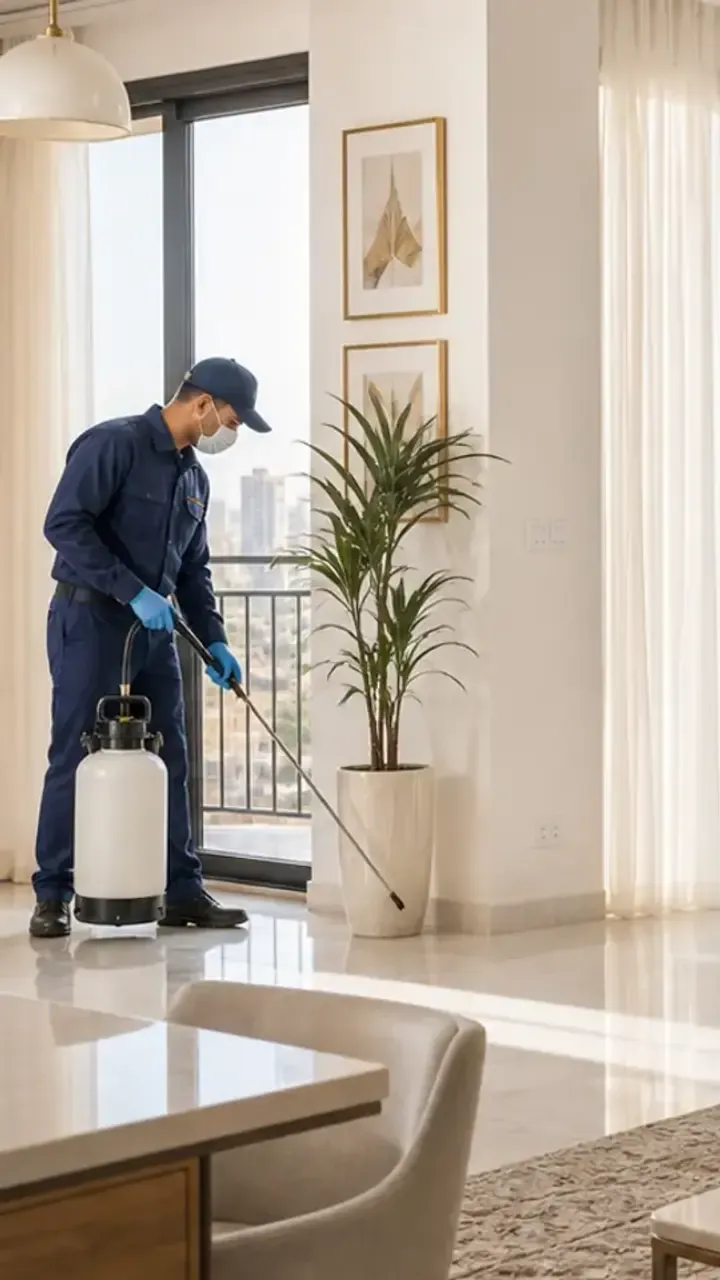
German Egypt Control: the guaranteed solution for your home and villa

Clothes Moth Control in Egypt: Save Your Wool and Rugs Before the Holes Appear

Took a jumper out at the start of winter and found it full of holes? Or a bald patch in the wool rug under the sofa? That's the work of clothes moth larvae. The small moth you see flying isn't the one eating; the larva hiding in the dark is. We inspect wardrobes and carpets, treat the places where the larvae live, and come back for a follow-up visit to deal with the eggs.

  • Inspection and quote before any work
  • Same-day technician anywhere in Egypt
  • Written guarantee
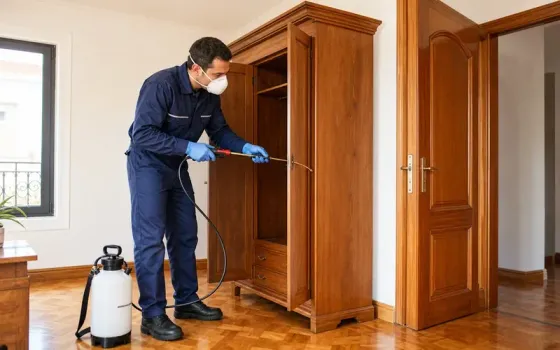
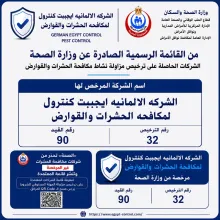
German Egypt Control technician carrying out clothes moth control The company’s Ministry of Health and Population licence Ministry of Health licenceLicence 32 · Reg. 90🔍 Tap to enlarge The company’s Ministry of Health and Population licence

Ministry of Health licence · Licence 32 · Reg. 90

We treat wardrobes and carpets before moths eat holes in your wool.

Spot the problem early

Signs you have clothes moths

  • Small, irregular holes in woollen jumpers, suits and shawls, often at the collar or under the arms.
  • Patches of wool carpet where the pile has thinned or gone, usually under sofas or beds that never move.
  • Fine silk threads stuck to the fabric, or tiny cases the same colour as the fabric that move slowly.
  • Very fine grains the same colour as the fabric at the bottom of the wardrobe or on a shelf.
  • A small, pale beige moth fluttering weakly inside the wardrobe and avoiding the light.

Where we usually find them:

  • Wardrobes
  • Carpets
  • Woollen furnishings
From the first call to the guarantee

How we get rid of clothes moths

  1. 1

    Inspecting wardrobes and carpets

    The technician opens the wardrobes and checks corners and high shelves, turns back carpet edges, looks under sofas and beds, and checks whether wool or linens stored for a long time are the real source.

  2. 2

    Preparing the clothes with you

    We tell you what to take out of the wardrobe, what to wash hot or send to the dry cleaner, and what to seal in a bag until it's cleaned, so larvae don't stay in the clothes.

  3. 3

    Treating wardrobes and carpets

    Once the wardrobe is empty we treat the inside corners, cracks and shelves, plus carpet and fitted-carpet edges and the areas under furniture, with approved residual products.

  4. 4

    Follow-up visit

    Eggs stick to fabric and cracks, so for heavy infestations we come back to treat newly hatched larvae before they grow and make new holes.

  5. 5

    Written guarantee

    You receive a guarantee certificate stating the cover period and the service carried out. If the moths return within that period, we come back at no extra charge.

One number to remember

Call us…and leave the rest to us

A trained technician, Ministry of Health approved products and a written guarantee after the visit.

Where and when clothes moths do their damage

A clothes moth larva looks for wool or silk somewhere dark that nobody moves. The winter wardrobe that stays shut all summer suits it perfectly, and so does the wool rug under the sofa that never gets vacuumed underneath. Wool put away unwashed attracts it most, because sweat and food traces make it better food.

That’s why the problem is usually found late. People open the wardrobe at the start of winter, the jumpers are full of holes, and the infestation has been going for months. The moth itself avoids light, so you won’t see it around a lamp like other moths. You’ll find it inside the wardrobe, or fluttering weakly in a closed room.

Not every hole is a moth

Carpet beetle larvae cause damage to wool and carpets that looks very similar, but the larva is a small hairy grub. Silverfish eat starched cotton and linen and tend to leave surface grazing rather than holes. And some holes are simply wear and tear with no insect involved.

The difference matters because the treatment area changes from case to case. If you send us a photo of the hole, the insect, or the grains at the bottom of the wardrobe, the technician can often tell you what you’re dealing with before the visit.

How we treat clothes moths

We inspect every wardrobe, not only the one with the problem, because moths travel with clothes from one to another. We check all the carpets too, especially the edges and the areas under heavy furniture, along with wool upholstery such as sofas, cushions and wall hangings.

Then comes preparation. Infested clothes are treated by hot washing or dry cleaning. Anything that can’t take that can be sealed in a bag and put in the freezer for a few days. This kills eggs and larvae in the fabric itself, since we don’t spray clothes.

After that we treat the empty wardrobe inside, plus carpets and fitted carpets, with Ministry of Health approved residual products. Most are low-odour and safe for children and pets when applied correctly. If the infestation was widespread, we come back for a follow-up visit.

Don’t put everything back at once. Return only what has been washed or cleaned, and keep the rest sealed in its bag. One piece with eggs in a clean wardrobe puts you back at the start.

Why moths come back every year

The cycle runs through the summer without anyone seeing it. Wool goes into storage in spring, sometimes unwashed, and the wardrobe is shut. The moths lay eggs and the larvae feed quietly for months. In winter people find the damage, spray the wardrobe or add mothballs, while the rug in the living room still has larvae nobody has touched.

So we treat every affected area in the same visit. If you own valuable pieces such as handmade rugs, fur or wool suits, store them clean and sealed and check them every few months rather than once a year. Catching it early is the difference between a small hole at the edge of a rug and a whole patch of pile gone.

Who has the most trouble with moths

Homes with wool or handmade rugs, and wardrobes holding suits, jumpers and linens stored for years. Flats that stay closed most of the year, like a holiday flat in Alexandria or the old family flat. Carpet, fabric and upholstery shops and clothing stores, where large quantities sit in one place. And homes with cats or dogs, because hair collecting in corners and under sofas suits the larvae well.

In a shop or store an infestation gets expensive, because the damage reaches the stock. It’s better to check early than wait for a customer to find the hole. Call us and we’ll arrange a visit outside your working hours.

After the treatment: what to do

  • Only put wool back in the wardrobe once it's clean. Sweat and food stains attract the larvae even more.
  • After washing, store winter clothes in well-sealed bags or plastic boxes with lids.
  • Vacuum carpets regularly, paying attention to the edges and the areas under sofas and beds.
  • Open and air wardrobes and move the things you don't wear. Moths like what nobody touches.

The price is set after the inspection

The cost of clothes moth control depends on the number of wardrobes and rooms affected, the area of carpet, fitted carpet and upholstery that needs treating, and whether the infestation needs a follow-up visit. We confirm the exact price before we start, and the inspection comes with no obligation.

After treatment you receive a guarantee certificate stating the period and the service, and if the problem returns within that period we come back at no extra cost.
A visit with us

From the first call to a good night’s sleep

  1. 1You call or WhatsApp usHi, I've got a clothes moths problem at home
  2. 2Booking confirmedService: Clothes moth control · Place: Villa · Inspection: Before any treatment
  3. 3The technician is on the waySame-day visits.
  4. 4The technician has arrivedIn company uniform, with all the equipment.
  5. 5Inspection firstWe identify the pest and its source before we start treatment.
  6. 6TreatmentTargeted extermination in and around pest nests · Ministry of Health approved products · Safe for children and pets
  7. 7A written guarantee in your handWe hand it to you before we leave.
  8. 8A quiet nightA clean home, without a single pest.

Your quiet day starts with a call.

Call or WhatsApp us and we’ll take it from there.

01066888859
Skip the story ↓↑ Back up
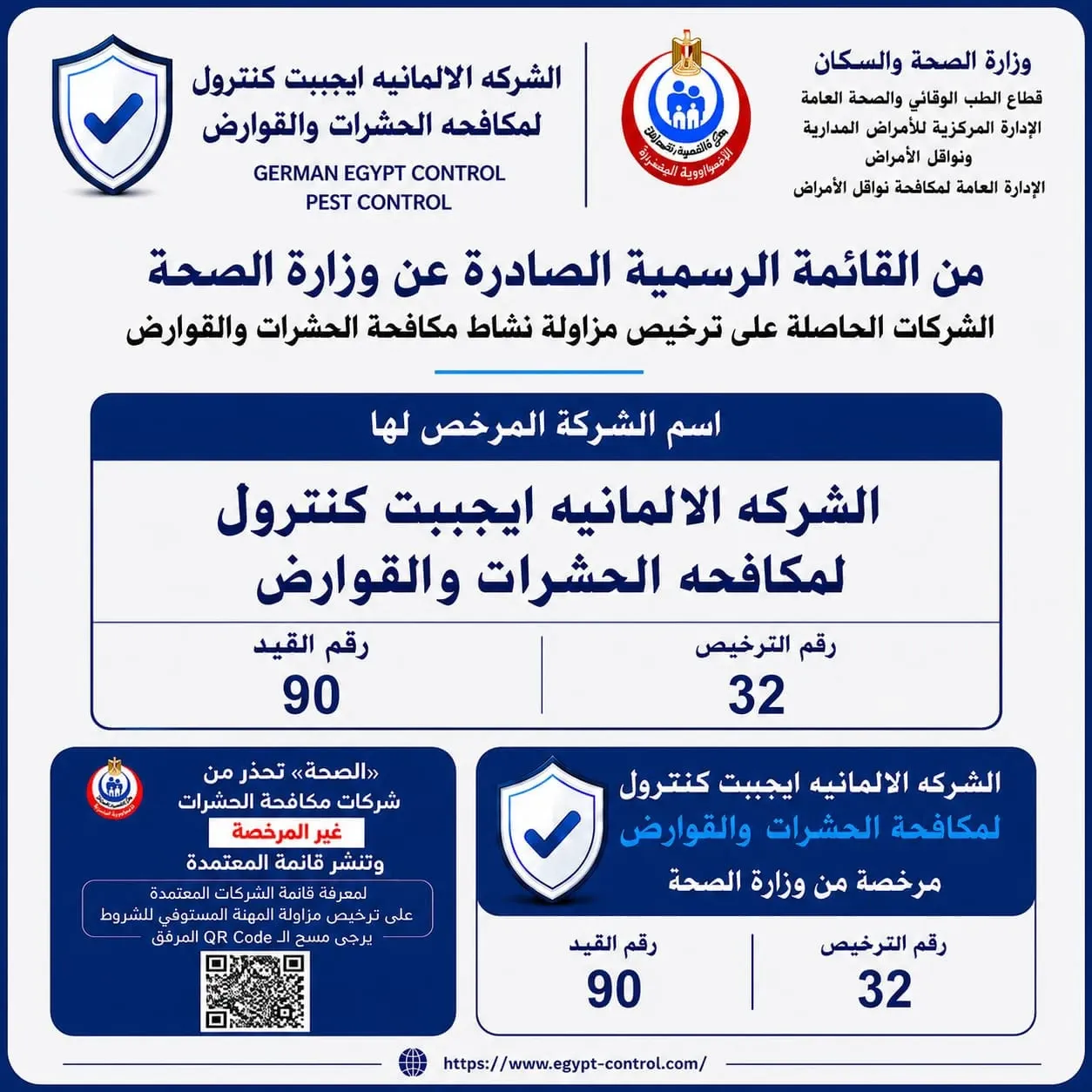
Ministry of Health licence for German Egypt Control

Licensed by the Ministry of Health, with the licence number right here

Our name is on the official list published by the Ministry of Health and Population of companies licensed for pest and rodent control. The Ministry itself warns against dealing with unlicensed companies, so always ask for the licence number before you let any company into your home.

Licensed company name

German Egypt Control Pest Control

الشركة الالمانية ايجيبت كنترول لمكافحة الحشرات والقوارض

Licence no.
32
Registration no.
90

General Department of Vector Control — Ministry of Health and Population

Ministry of Health and Population licence: German Egypt Control Pest Control, licence no. 32, registration no. 90 View the full-size licence
From the Ministry of Health's official list of companies licensed for pest and rodent control (in Arabic)
📞 Waiting for your call

One call…and the pests are gone

Call us now: an inspection first, then treatment with Ministry of Health approved products and a written guarantee.

Contact

German Egypt Control

01066888859

✓ Licensed by the Ministry of Health
Questions we hear a lot

Clothes moth control: frequently asked questions

We've gathered the questions we're asked most, with straight answers.

Still have a question?

Call or WhatsApp us and we'll answer right away.

Is the moth I see the one eating my clothes?

No. The adult moth doesn't eat fabric; the larva does. The moth lays eggs on wool or carpet, and they hatch into tiny larvae that feed on wool, silk and fur. That's why killing the moths you see flying isn't enough. The treatment has to reach the places where the larvae are living.

Aren't mothballs enough?

Mothballs can keep moths out of a tightly closed wardrobe, but they don't treat an infestation already in the carpets and corners. The smell is strong and stays in clothes, and they must be kept away from children and pets. If moths keep appearing despite mothballs, the source is somewhere else and needs an inspection.

Do clothes moths eat cotton and polyester?

Clothes moth larvae prefer animal fibres such as wool, silk, cashmere, fur and feathers. Cotton and synthetics aren't their main food, but they can be damaged if blended with wool or stained with sweat or food. That's why the damage shows up far more in jumpers, suits and wool rugs than in T-shirts.

There are moths in my flour and rice. Are they the same kind?

No. Those are usually pantry moths, a different species that lives in flour, rice, nuts and dried fruit and leaves clothes alone. Treatment starts with throwing out the infested food and cleaning the shelves, then we treat the cracks in the kitchen cupboards. Send us a photo on WhatsApp and we'll confirm the type before the visit.

🎁 Special limited-time offer - 35% off when you call us now

Ready to get rid of pests for good?

One call and we're on our way. An inspection, a clear quote and a written guarantee, in every governorate of Egypt.

  • Licensed by the Ministry of Health
  • Safe for children and pets
  • Written guarantee