
Termites: What They Look Like, Signs in Your Home, and How They Differ From Woodworm
Termites aren't ants. Learn the signs of termites at home, termites vs ants and woodworm, and how termite control works in Egypt. Send us a photo on WhatsApp.
 Ministry of Health licenceLicence 32 · Reg. 90🔍 Tap to enlarge
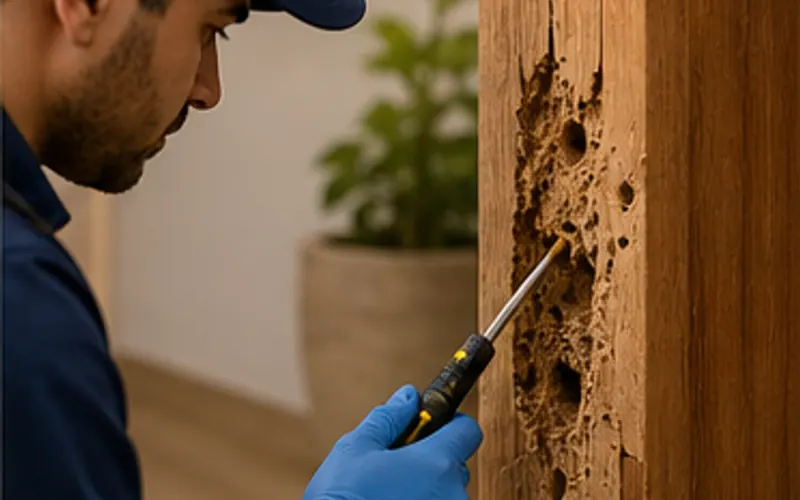
Termites are insects that live in underground colonies and eat wood from the inside. Despite the old name ‘white ants’, they aren’t ants at all. The usual signs of termites are thin mud tubes climbing a wall, wood that sounds hollow when you tap it, and piles of clear wings dropped near a window. Treatment isn’t a supermarket spray. It starts with an inspection that finds where they’re getting in, followed by a soil barrier or baits and treatment of the infested wood.
Not sure what you’ve found? First tell termites apart from ordinary ants and woodworm, since each needs a different treatment. Then see what to do today, and what to avoid before the inspection.
What are termites?
Termites are social insects living in large colonies where every individual has a job. Scientifically they aren’t related to ants: biologists place them with cockroaches, and a worker looks more like a soft grub than an ant.
They feed on cellulose, found in wood, paper, cardboard and sometimes cotton fabric. Microorganisms in their gut digest it for them, so almost anything of plant origin is food, from a door frame to boxes of old books.
Most damage in homes here comes from subterranean termites. Their colony is underground, often beside the building rather than under it, and workers leave it daily to find wood. A second, less common type lives inside dry wood and needs no soil. It leaves a different sign, covered in the termites vs woodworm section below.
In recent years there have been reports of termites in old houses in Alexandria and in village homes around Luxor and Upper Egypt, especially those with wooden roofs or next to farmland. Other governorates aren’t immune: anywhere with damp soil near wood can have the same problem.
What termites look like in each caste
Most people have seen only one member of the colony, which causes confusion. A colony has several castes that look quite different, each with its own job.
Workers
Workers are the majority. They eat the wood, build the mud tubes and feed the others. They’re creamy white or pale beige, soft and slightly translucent, and under half a centimetre long in the common species. They have no wings, and in most species they’re blind.
You rarely see workers unless you break open a mud tube or infested wood, when small pale insects rush to hide from the light. That sight is where the ‘white ant’ name comes from.
Soldiers
Soldiers are fewer and defend the colony against ants and other enemies. The giveaway is the head: much larger than the body suggests, darker (yellowish to brown), with strong visible jaws. The body is pale like a worker’s.
If you open a mud tube and see insects with big dark heads guarding the opening, those are soldiers. They don’t attack people.
Flying termites (swarmers)
This is the form most people see, as it’s the only one that seeks out light. Flying termites are the future kings and queens of new colonies. They’re darker than workers, brown to almost black, with eyes and four clear wings of about equal length, all longer than the body.
They swarm in warm weather, mostly spring and early summer, often after rain or on a hot, humid day, taking off at once in large numbers around lamps and windows. Soon after, they drop to the ground and shed their wings, and a male and female walk off in tandem to find damp soil and wood for a new colony.
That’s why a pile of shed wings on a windowsill or under a light matters more than the insects themselves. If the swarmers came out from inside the house, through a crack in the tiles or a door frame, an active colony is very close and big enough to produce them.
The queen and king
You’ll almost never see them. The queen grows enormous, lives for years and only lays eggs. That’s why killing the workers in front of you solves nothing while she’s still working underground.
What termite damage looks like in wood
This matters more than the insect itself. Subterranean termites eat wood from the inside along the grain, softer parts first. Open an infested piece and you’ll find long parallel galleries, almost like layers, with mud or damp soil stuck to the walls.
From outside, the wood can look perfectly sound. Termites leave a paper-thin surface shell that protects them from light and dry air, so a finger or screwdriver tip may push straight through. There are no small round holes like woodworm, and no fine powder on the floor.
Termites vs ants
Mixing these up wastes time, because the treatments are completely different. People put ant gel on mud tubes, or ask for foundation injections for sugar ants on the counter. Compare the winged forms, since both produce flying swarmers and that’s where most confusion happens.
| Feature | Termites | Ants |
|---|---|---|
| Antennae | Straight, like a string of tiny beads | Bent in the middle, like an elbow |
| Waist | Broad, straight body with no waist | Clearly pinched waist between thorax and abdomen |
| Wings (in swarmers) | Four wings of about equal length that drop off easily | Front wings clearly longer than the back wings |
| Colour | Workers white or cream, swarmers dark brown | Usually black, brown, red or yellow |
| Where you see them | Rarely in the open, hidden inside wood and mud | Walking in visible trails on floors and counters |
| What they eat | Wood, paper and cardboard | Sugars, protein and food scraps |
Ordinary ants are a kitchen and bin problem. Annoying, but they don’t eat the house. Termites are the opposite: you won’t see them near the sugar, and left alone they’ll keep eating wood for months.
If you do have ordinary ants, treatment is much simpler and mostly means bait that reaches the colony. The details are in our article on ant control in Fifth Settlement, and the advice applies anywhere.
Termites vs woodworm
Here the confusion is worse, because both damage wood, yet they’re completely different creatures. Woodworm is a beetle larva: the beetle lays eggs in the wood, and the larvae bore and feed inside until they mature and emerge. Termites come from outside, from the soil, and enter the wood through mud tubes.
The simplest test is what’s around the piece. Woodworm leaves small round holes with clean edges, and below them a pile of fine, flour-like dust that returns every time you clean it. Subterranean termites don’t make holes like that or push dust out. If anything, they seal every opening with mud.
| Comparison | Termites | Woodworm |
|---|---|---|
| What it is | A social insect living in a colony with a queen, workers and soldiers | The larvae of certain beetles, each larva working alone |
| Where it comes from | The soil, or a colony next to the building | Eggs laid in the wood itself, second-hand furniture, or untreated timber from the workshop |
| Sign on the wood surface | Mud tubes, and a thin shell that breaks when pressed | Small round exit holes, roughly 1 to 2 mm in the common species |
| What falls on the floor | Clear wings during swarming season | Fine powdery dust that returns after cleaning |
| Inside the wood | Long galleries along the grain, with mud and damp soil | Winding tunnels packed with dry powder |
| Needs moisture? | Yes, subterranean termites can’t survive without it | No, it lives in ordinary dry wood |
| Insect you might see | Brown swarmer with four equal wings | Small brown or black beetle near the window |
| Speed of damage | Can be fast, because the colony is huge | Slower, getting worse year after year |
| Treatment | Soil barrier or bait, plus treatment of the wood | Injecting product into the holes and treating bare timber |
One case muddles the table: drywood termites. They build no mud tubes, and they push small dry pellets out of tiny openings, a bit like coarse sand. Up close the pellets have a clear shape and size, while woodworm dust is fine and rubs away between your fingers like flour. If you’re unsure, take a close-up photo of what’s on the floor next to a metal coin. That photo alone tells us a lot.
Both can be in the same house, especially older homes with lots of woodwork, so an inspection checks for both. If you have woodworm rather than termites, the treatment is different; see our woodworm treatment page.
Signs of termites in your home
Most people find termites by accident, while moving a wardrobe or replacing a skirting board. These signs run from most to least obvious.
Mud tubes on walls or foundations
This is the key sign: thin channels of mud and soil, about as wide as a pencil, rising from the ground up a wall, running beside a pipe, or disappearing behind a door frame or skirting board. Termites build them to travel from soil to wood without meeting dry air.
Check the basement, under the stairs, beside pipes, behind the washing machine and under the kitchen sink. Pale insects inside a broken piece mean the tube is active; an empty, dry one may be old or abandoned.
Hollow or crumbling wood
Tap door and window frames, skirting boards and parquet with the back of a screwdriver. Sound wood knocks solid; infested wood sounds hollow, like a box. If the tip sinks in easily, or the surface breaks to show mud underneath, that’s termite damage.
Discarded wings near windows and lights
Look for clear wings of equal length on a windowsill, in a cobweb or under the balcony light, usually left after a single warm day. Wings inside the flat, not just on the balcony, are more serious.
Doors and windows that suddenly stick
Termites bring moisture into the wood, which swells, so a door that closed fine starts catching. Humidity or settling can do the same, but if it’s a frame near the floor in a damp spot, tap it and check the wall beside it.
Bubbling paint and sagging floors
Termites moving through a wall under paint or wallpaper leave bubbles or peeling lines, sometimes with soil beneath. Parquet or wooden floors may creak, sink in one spot or warp, because the wood underneath has been eaten.
Damaged paper and boxes in storage
Boxes stored on a basement or roof floor, or old books on a shelf against a damp wall. If you lift a box and the side facing the wall is eaten and muddy, that’s a clear sign, even if the woodwork looks fine so far.
Mud in tile joints or behind skirting
Damp soil or mud coming out of tile grout, or from the gap between skirting and wall. In tiled flats with little woodwork this is sometimes the first thing to show, as termites come up under the tiles looking for the nearest wood.
What causes termites in a house
The question we hear constantly is, ‘Our home is clean, so where did they come from?’ Cleanliness has little to do with it. Termites come for wood and moisture, not food, and any home with the two close together can attract them.
The causes we see most often:
- A constant leak in a wall or under the tiles, from a pipe, bathroom or tank, keeping the spot damp.
- Wood touching the soil, such as a ground-floor door frame reaching the earth, a wooden garden fence, or benches and decking on bare ground.
- Heavy garden watering right by the wall, or plants and trees against the foundations, so the soil never dries.
- Air conditioner condensate dripping on the same spot by the foundations all summer.
- Offcuts of wood, cardboard or tree stumps buried in or near the house during construction or finishing.
- Cracks in the foundations or outdoor paving that let termites in without exposure to light.
- Old houses with wooden roofs or mud brick walls, or built right up against farmland, common in villages and Upper Egypt.
In villas and compounds, watering and planting against the walls create ideal conditions, so inspections there often cover the outside too, as explained in our article on ant control in El Rehab.
Upper floors aren’t fully protected either. Termites can travel up inside walls beside pipes and cables, although ground floors, basements and villas are hit far more often.
Why termites are a risk to your home and furniture
Termites don’t eat concrete or red brick, and a concrete building won’t collapse because of them. The risk is to everything wooden, which is more than you’d think.
Door and window frames, skirting, parquet, built-in wardrobes, kitchen cabinets backed against the wall, bookcases, and the wooden roofs of old houses can all be eaten from inside while looking fine. By the time you notice, they usually need replacing, not repairing.
In old houses with roofs of timber beams and palm fronds, the danger is greater because that wood carries weight. A beam eaten from inside can weaken with no visible sign from below. In that kind of house, waiting isn’t an option.
People also forget paper: contracts, certificates and old photos in basement boxes can’t be replaced.
As for health, termites aren’t known to spread disease to people and don’t bite humans in normal conditions; the threat is to wood. If someone at home has a severe allergic reaction or irritation from the dust or wings during swarming, see a doctor.
The damage also grows: every month the workers reach new wood, so treatment plus carpentry costs more the longer you wait.
What to do until the pest control company arrives
If you’ve found one of these signs, here are simple things to do today, and things to avoid so the inspection isn’t harder:
- Don’t knock down the mud tubes or spray inside them. They’re the map the technician follows to the source. Break them and the termites build new ones elsewhere, and the search starts over.
- Photograph everything before touching it: tubes, damaged wood, wings, and any pellets or powder on the floor. Put a metal coin or ruler beside them for scale, and take a wider shot of the area too.
- Keep a sample. Collect a few swarmers or wings in a sealed clear bag or small jar. It settles termites versus ordinary flying ants in seconds.
- Don’t spray the swarms every time they appear. Most swarmers indoors die on their own, and spraying won’t touch the colony that produced them. Vacuum them up, bin the bag outside, and on swarming nights switch off lights in rooms near windows.
- Stop any water source you can: the leaking sink, AC condensate dripping on the foundations, garden watering against the wall. It won’t kill termites, but it makes the spot less attractive.
- Move boxes, paper and stored wood away from the affected wall, and off the floor if you can.
- Don’t move suspect furniture to another room until you know what it is, especially if there’s powder or pellets around it. If it’s woodworm or drywood termites, you could spread the infestation.
- Note when and where each sign appeared: the swarm day, the room, the wall. It helps the technician find the route faster.
Common remedies that don’t work on termites
Most advice from the internet and neighbours was meant for ordinary ants or has no basis at all.
Vinegar, salt, mint, cinnamon and lemon peel may make a line of ordinary ants change course for a day or two, but they don’t kill an ant colony and do nothing to termites, which are inside the wood and soil and won’t smell anything on the surface.
Kerosene, diesel or petrol on the wood or in the tubes is one of the most dangerous things you can do at home. It’s a real fire risk, the smell lingers for days, and it never reaches the colony underground. The same goes for mixing cleaning products or chemicals. Never do it.
Some people buy loose agricultural pesticide from a farm supply shop and spray it at home. This is prohibited. Unlabelled farm pesticides are made for open fields, not a bedroom with children and pets, and their doses have nothing to do with a home. Keep them out.
Ordinary spray on the wood surface kills only the workers in its path, and painted or varnished wood doesn’t absorb it anyway. Sometimes the termites avoid the sprayed spot and surface elsewhere, so the route gets lost.
Ant powder and chalk only redirect ordinary ant trails. Gel baits and boric acid tablets partly work on ordinary ants, which carry them home, but termites won’t go near them.
So what works without a company? Removing the causes: drying out damp areas, fixing leaks, separating wood from soil, keeping plants and watering away from the foundations, and removing buried wood and cardboard. Preservatives on bare timber before painting can lower the risk for new wood but won’t kill an existing colony. That’s prevention, not treatment.
How termite control works
Termite treatment happens in stages, each depending on the last. Expect this from any reputable company.
Inspection and identifying the species and route
The technician confirms it’s termites, not woodworm or ants, then follows the tubes and damaged wood to the entry point: foundations, a tile joint, a pipe, or the garden. They tap woodwork, check the basement, ground floor and exterior, and may use a moisture meter on the walls.
This inspection decides the treatment and the price. Without it, anyone quoting a price over the phone is guessing.
A soil barrier around the foundations
This is the best known termite treatment for subterranean species. The technician injects a dedicated product into the soil beside the foundations and under the tiles, through small holes drilled in the floor or at the base of the wall, then seals the holes. This creates a treated zone in the soil between the colony and the house.
Some products are undetectable to termites, so they walk through, carry some back and pass it to others, reaching further than the injected area. The amount and hole spacing depend on soil type and route length.
Bait stations
In some cases, or alongside a barrier, bait stations go into the soil around the house or directly onto tubes indoors. They hold cellulose with a slow-acting active ingredient that stops workers developing properly. Workers feed on it, carry it home, and it spreads slowly through the colony.
Baiting takes weeks or months depending on colony size, with the technician returning to check and refill the stations. It needs little drilling, which suits awkward spots.
Treating the infested wood
The damaged wood is treated by injecting product into the galleries or treating its bare surface, so any termites left inside die and don’t return. Wood too weak to bear load, like a hollowed door frame or crumbling threshold, is better replaced. An honest technician will say so from the start and won’t promise treatment makes it good as new.
Don’t replace infested wood before the barrier or bait is working. New wood on the same route will be eaten too.
Follow-up and guarantee
Some time after treatment, the technician rechecks the old tube sites and woodwork. No new tubes and no fresh mud in treated areas means the route has stopped. If tubes reappear somewhere, that spot is retreated. You then receive a written guarantee stating the period and type of service.
If you’re building or finishing
The easiest time for termite treatment is before floor tiles go down. Treating exposed soil covers the whole floor without drilling. If you’re building a villa or house in an area known for termites, ask about this before the contractor pours or tiles.
Termite prevention
Prevention means making your home unattractive to termites, not spraying something every month. Most of it is ordinary maintenance:
- Fix leaks as soon as you see them, and don’t accept a damp wall as ‘normal for old buildings’.
- Route AC condensate into a drain or away from the foundations.
- Leave a gap between plants and the wall, and keep watering away from the foundations where you can.
- Don’t let any wood touch the soil, whether a fence, bench or door frame.
- Don’t store wood, boxes or newspapers on basement or roof floors. Use metal shelves away from the wall.
- Remove tree stumps and leftover wood from the garden and around the house.
- Every few months, check the basement, under the stairs and beside pipes for mud tubes.
- Buying or renting a ground-floor flat or an older villa? Ask for a termite inspection before you sign.
- Use treated, properly dried timber for new carpentry, especially on the ground floor.
When do you need a pest control company?
With ordinary ants you can try bait yourself first. Termites are different: any confirmed sign means a working colony underground, and there’s no home remedy for that. Call a company if:
- You find mud tubes on a wall, frame or pipe, even just one.
- You find lots of shed wings indoors, or flying insects emerging from tiles or woodwork.
- Wood sounds hollow or crumbles, or the parquet is sinking in one spot.
- The house has a wooden roof, or is old and next to farmland, and you’ve seen any of these signs.
- You’re building or finishing in a termite area and want the soil treated before tiling.
- You can’t tell whether you have termites, woodworm or ordinary ants.
In that last case, a clear photo is usually enough for us to tell you which. Send it on WhatsApp to 01022888444 or call 01066888859.
German Egypt Control is licensed by the Ministry of Health and Population, licence no. 32 (registration no. 90), and handles termite control in Egypt across most governorates, from pest control in Cairo and Giza to Alexandria. In most areas the technician comes the same day, and we tell you the problem and the price before any work starts. Our products are Ministry of Health approved, safe for children and pets when applied correctly, and mostly low-odour, and you get a written guarantee for a set period. Termite pricing depends on the route length and how much wood is affected.
The service and its steps are on our ant and termite control page, and to see how we work in a specific area there’s an article on German Egypt Control’s ant control in Fifth Settlement. For other insects, all our services are on the services page, and there’s a general overview of pest control for homes and businesses.
The bottom line
Termites aren’t ants, and they aren’t a cleanliness problem. They’re a soil colony that reaches wood through mud tubes and eats it from the inside, leaving it looking intact. The clearest sign is mud tubes, then wood that sounds hollow, then the pile of wings by a window on a warm day.
Tell termites from ants by the waist, antennae and wings, and from woodworm by the holes and dust. Don’t waste time on vinegar, diesel or farm pesticides, and don’t break the tubes before the inspection. Take photos, keep a sample, deal with the damp, and book an inspection.
Real termite treatment is a soil barrier or bait, plus treating the wood and a follow-up visit. The earlier it starts, the less wood you’ll have to replace.
Frequently asked questions
What causes termites to appear in a house?
Constant moisture next to wood. Termites live in the soil and need water, so they move in when they find a wall damp from a leak, a door frame touching the ground, a garden watered against the foundations, or wood and cardboard buried in the backfill. Clean homes get termites too, because they come for damp wood, not food.
What is a termite nest called?
An ordinary ant nest is usually called a nest or colony, and its opening is the entrance hole. A termite home is also called a nest or colony, and in Africa and Australia some species build tall mud mounds. The species that damage homes in Egypt usually nest underground and reach the wood through thin mud tubes.
What is the best termite killer?
There is no single product you can buy, spray and be done with. Termites are treated with a soil barrier around the foundations or with bait stations that workers carry back to the colony, plus treatment of the infested wood. These products must be Ministry of Health approved and applied by a licensed company. Never use unlabelled agricultural pesticides indoors.
Do termites eat wood?
Yes. Wood is their main food, along with paper, cardboard and anything else containing cellulose. They eat wood from the inside along the grain and leave a thin outer shell, so the piece looks intact while it is hollow. Tap it and it sounds hollow; press with a screwdriver and it may sink in to reveal mud.
How do you get rid of termites?
Start with an inspection that identifies the species and the route the termites use. The technician then injects a product into the soil beside the foundations and under the tiles to form a barrier, or installs bait stations, and treats the infested wood. A follow-up visit confirms the mud tubes haven't returned. Spraying wood surfaces never reaches the colony.
What smell do ants hate?
Ordinary ants may avoid vinegar, mint, cinnamon or lemon for a while, because these smells confuse the scent trail they follow. With termites, smells do nothing at all. They live inside wood and soil, the colony won't react to a scent on the surface, and every week spent on home experiments is more wood eaten.